Product Requirements Document (PRD)
Categories:
Product Requirements Document (PRD)
Project Name: Peregrine
Feature/Version Name:[Name of the feature or version being described]
1. Introduction
This is a product requirements document that outlines high level feature set for the entire Peregrine version of the Phenom app.
1.1 Purpose: To enumerate critical functionality for Phenom, a competitive gamified app for capturing UAP/Cryptids/Paranormal.
1.2 Scope: App will be distributed to Android and iPhone user platforms
1.3 Goals: Monetized gamified video capture that is undebunkable (meaning tagged with c2pa standard) and annotated for further study.
1.4 General terms
 Phenom - general term for a user recorded event
 Teams - users can form teams to record things together
2. User Stories (Issue References Only)
- Please provide links to existing User Story issues in Linear.
- [Add more User Story issue links]
3. Functional Requirements
App Frontend Features
3.1 Video Capture
- single button to record video
- Preserves C2PA metadata when recording is collected.
- Pair video and audio with sensor metrics from any other sensors attached (See Sensor Usage)
- Display other internal sensor data over screen as buzzard does
- Camera Modes
- Recording tips on/off
- tell user to stop shaking
- tell user to record some terrain
- ID Augmented Reality Mode: AR mode with all the satellites, planes, and so on. Just to check what is in the sky.
- Live Capture Mode: Turns off ID Augmented Reality view. Engages recording with ‘zen focus’ effect.
- Test Capture: same as Capture, but without saving the data to Phenom.earth cloud storage. Provide a browse, share to The Phenom App and delete test files feature.
- Recording tips on/off
- segment known items such as
- satellites
- planes
- ships
- planets
- meteors
- AR overlay is available before and after recording, can be toggled.flowchart TD A([User Presses Record]):::action --> B([Vision Camera v5]):::tech B --> C([Sensor Data Collection
GPS, Gyro, Compass]):::tech B --> D([Video Stream]):::tech C --> E([C2PA Metadata
Embedding]):::feature D --> E E --> F([Post-Recording
Edit Screen]):::action F --> G([Upload to
Cloud Storage]):::deploy classDef action fill:#d73429,stroke:#ffffff,color:#ffffff,rx:30 classDef tech fill:#121010,stroke:#a5e3e8,color:#a5e3e8,rx:30 classDef feature fill:#151515,stroke:#d73429,color:#ffffff,rx:30 classDef deploy fill:#1a1a1a,stroke:#a5e3e8,color:#ffffff,rx:30
- segment known items such as
3.2 post recording editing screen
- allow clipping of video before upload to The Phenom App cloud storage etc.
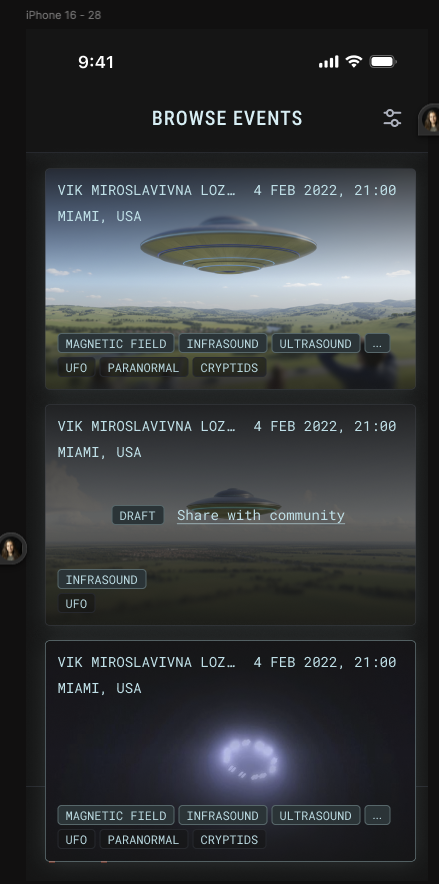
3.3 Data display and interaction
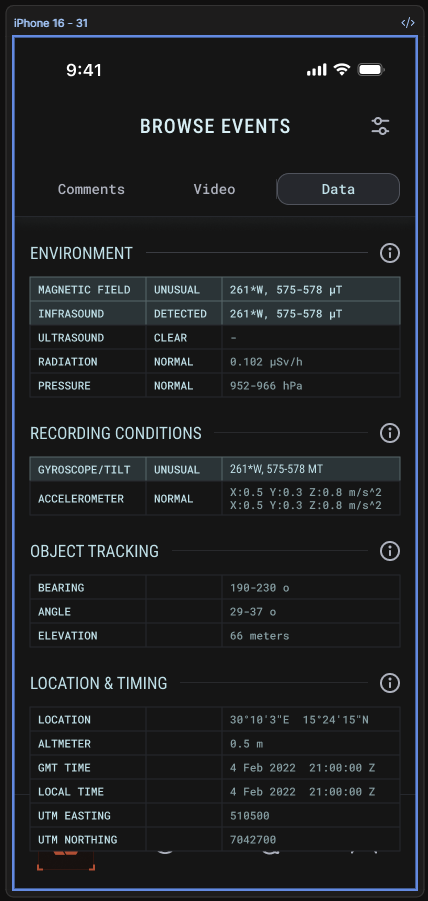
- Summary screen of video (once recorded)
- 3D globe or map view showing events as well as data layers such as Airplane and Satellite traffic that happened during video
- show stats such as bearing and location
- video metrics
- Event viewing tool
- normal playback screen
- ability to overlay other known objects (see AR recording mode)
- possible data sources
- ADSB (airplanes)
- AIS (ships)
- More..?
- could be planetarium style view
- could be premium feature
- possible data sources
- The Phenom App Content Navigation Screen
- 3D globe as is currently done in Enigma or Google Earth
- magnifying glass in upper right
- allows search by things like
- username, team, tag
- allows search by things like
- 2 major range sliders, distance and time
- distance slider to adjust show all events within X km/miles from pin drop (defaults to user GPS locale)
- Calendar icon to select date + time slider for specified time period preceding date.
- magnifying glass in upper right
- 3D globe as is currently done in Enigma or Google Earth
- The Phenom App Data Visualization Features
- Turn on Heatmaps
- filter by tag
- include 3 heatmap mode checkboxes UAP/cryptid/paranormal.
- Turn on Event Altitude Stick - applicable when 2 users capture an overlapping event. (see growth section)
- Investigation Incident Command View - Shows all resources aligned with a specific investigation event. This could be Phenom App Team members, sensor packages, for planned observation events.
- Turn on Heatmaps
- Summary screen of video (once recorded)
3.4 User interaction rewards
- users who record multiple views of same event can get rewards
- users who record lots of events can get rewards as well
- rankings
3.5 Education
- onboarding screen and test area
- Educational materials on how to film properly.
- could be quick through tutorial that loads on app install
- could be recording a bird for example.
- Test recording walk-through of using the app. Video doesn’t upload to the database.
- Types of observed UAP (descriptors or tags of observed shapes)
- Types of observed Cryptids
- Types of paranormal observations
- onboarding screen and test area
3.6 Phenom 15 Second Preview of Recent Activity
3.7 Equipment store and purchase
- Links to buy additional sensors and equipment
- links to buy tshirts and swag
3.8 User profiles
name
address
profession
etc
App Backend Features
3.10 Backend data sharing API
- Should be compatible to share to other orgs (NASA whatever)
- offer 3rd party integrations in a limited fashion. Possible integration techniques:
- webhook?
- RSS?
- Other DBs:
- MUFON
- NUFORC
3.11 General app backend
- Data is annotated and curated to suit further API-based analysis.
- Desktop website features
- Reproduces all Data Viz available in the mobile app.
- Growth ideas
- grouping videos into events automatically
- how do we figure out if users are seeing the same thing?
- how do we run detailed automated analysis on multiple videos (sensor fusion)
- doing trajectory extrapolation to notify people that something might be coming
- could be triggered in high volume event cases
- we should think about ways to facilitate this
- grouping videos into events automatically
6. Non-Functional Requirements
4.1 Performance:
- App must maintain 60fps during camera recording to ensure smooth capture of fast-moving phenomena.
- Map rendering must handle 1000+ H3 hexagons without frame drops or UI jank.
- Video processing (FFmpeg operations, C2PA signing) must run off the UI thread to keep the interface responsive.
- MMKV storage is used for fast local data access, replacing AsyncStorage for performance-critical paths.
4.2 Security:
- C2PA (Coalition for Content Provenance and Authenticity) content credentials are embedded in all captured media to establish authenticity and chain of custody.
- MMKV encrypted storage is used for sensitive local data (tokens, user preferences).
- Authentication is handled via OAuth 2.0 through AWS Cognito.
- In-app messaging uses the Matrix protocol, which provides end-to-end encryption and decentralized architecture.
4.3 Usability:
- The app supports 7 languages: English, Spanish, French, German, Japanese, Chinese, and Arabic (with full RTL layout support).
- Video capture uses a single-button interaction to minimize complexity during time-sensitive recording situations.
- The camera HUD displays a compass and live orientation data (pitch, roll, yaw) to assist with directional documentation.
- UI components follow platform accessibility guidelines (iOS Human Interface Guidelines, Android Material Design) for screen reader and contrast compliance.
4.4 Scalability:
- H3 hexagonal geospatial indexing is used for spatial queries, enabling efficient global-scale event lookups at multiple resolution levels.
- The API layer uses an adapter pattern, allowing the backend to be swapped or extended without rewriting the frontend.
- Hasura GraphQL with PostgreSQL provides a scalable relational data layer capable of handling concurrent submissions from a large user base.
7. UI/UX Design
Figma: Design assets and component libraries are maintained in the team Figma workspace. Reference Figma for approved layouts, color tokens, spacing, and component specifications before implementing any new screens.
Key UI/UX considerations:
- The camera HUD is rendered using Skia (via React Native Skia) to achieve high-performance, hardware-accelerated overlays without impacting the camera pipeline.
- The app uses a dark theme optimized for low-light and night sky observation scenarios, reducing eye strain and improving screen visibility in dark environments.
- Bottom tab navigation provides access to the five primary areas: Home, Map, Record, Sensors, and Chat.
- Design tokens (colors, typography, spacing) are kept in sync between the Figma source of truth and the codebase to prevent visual drift across releases.
8. Technical Requirements
- App should record battery level voltage as an internal logging function.
- React Native 0.81.5 with Expo SDK 54.0.31 is the application framework.
- TypeScript is required throughout the codebase for type safety and maintainability.
- EAS (Expo Application Services) is used for managed builds and over-the-air update delivery.
- Vision Camera v5 provides frame-level camera control required for the recording HUD and AR overlays.
- FFmpeg Kit handles all video processing operations (trimming, re-encoding, C2PA injection) off the main thread.
- Mapbox GL powers the 3D globe and 2D map views with support for custom data layers.
- Matrix JS SDK is integrated for secure, encrypted in-app team messaging.
9. Release Criteria
- All critical user flows are functional end-to-end: record a phenom, view event details, use team chat, and browse the map.
- C2PA metadata is successfully embedded and verifiable in all captured media before upload.
- Sensor data (compass, accelerometer, GPS) is correctly paired and stored alongside video recordings.
- App crash rate does not exceed 1% as measured in production telemetry.
- TestFlight (iOS) and Google Play internal testing (Android) beta rounds are complete with no blocking issues outstanding.
- Performance benchmarks are met: sustained 60fps during recording and app cold-launch time under 3 seconds on reference devices.
10. Open Issues/Questions
- AR overlay data source licensing: usage rights for ADSB (aircraft), AIS (maritime), and satellite position feeds need legal review before public launch.
- Monetization model: the pricing and gating strategy for premium features (heatmaps, event altitude stick, advanced visualization) has not been finalized.
- Data sharing agreements with MUFON and NUFORC are pending; the format and frequency of data exports need to be negotiated.
- Event auto-grouping algorithm design is unresolved — the approach for determining whether multiple user recordings capture the same phenomenon (sensor fusion, location overlap, timestamp correlation) requires further technical design work.
11. Notes/Ideas
- Desktop website feature parity (section 4) is planned as a post-mobile-launch milestone. The mobile app is the initial delivery target; web data visualization will follow.
- Growth features listed in section 5 (trajectory extrapolation, automated event grouping) are explicitly post-MVP. They should not gate the initial release.
- As UAP reporting standards evolve (e.g., through government or academic bodies), consider building integration hooks early so the platform can participate in emerging data exchange protocols without requiring a major rearchitecture.
Feedback
Was this page helpful?
Glad to hear it! Please tell us how we can improve.
Sorry to hear that. Please tell us how we can improve.